The first local Nashvillians to try their hand at the steel guitar were inspired by the Native Hawaiians who appeared between 1909 and 1935 at the downtown Vaudeville Theatres, hotels, city clubs, high school auditoriums, retail stores, small cafes, YMCAs, community centers, roof garden parties, the Tennessee State Fair, the Tennessee State Prison, and the Ryman Auditorium.
Even before 1909 locals would have seen and been inspired by Hawaiian steel players criss crossing the South in tent shows, medicine shows and circus's during the early 1900s and before 1909. Unfortunately, no specific sources or personal reminiscences survive to name these early local steel players or when they were first active.
The first mention of local Nashville Hawaiian-style steel guitar players in the Nashville newspapers was in 1916 and 1917 naming: Sterling Melvin, Grady Gowan, and Ivo Glenn. They all played steel guitar as a sideline: Sterling Melvin was dentist, Grady Gowan a traveling salesman for Armor & Company, and Ivo Glenn a lawyer. They also were also prominent citizens frequently mentioned in the Nashville society pages.
Ivo Glenn was one of these early local Nashville Hawaiian-style steel players. On April 28, 1917, the Nashville Banner announced "a Hawaiian quartet" on the bill at the 27th Annual Vanderbilt Glee Club concert to be heard Friday, May 4, 1917, at Lowe's Vendome Theatre on Church Street.
"The club is composed of twenty-four singers and entertainers chosen by competition from the student body of 1,100 students. There are three accompanists, a quintette of instrumentalists. a Hawaiian quartet, soloists and a trio of vaudeville artists. . . . There are three accompanists, a quintette of instrumentalists. a Hawaiian quartet, soloists and a trio of vaudeville artists. . . . . Instrumental Quintette-Messrs. Davis, Glenn, Searight, Milam, Dasher. Accompanists-Messrs. Heagen, Dasher, Searight." (Nashville Banner, April 28, 1917)


(Nashville Banner, April 28, 1917)
"With a change, to island scenery and under the soft lights: a quartette of naturalized Hawaiian singers will delight the audience with the soothing melodies of the steel guitar and ukelele." (Nashville Tennessean and The Nashville American, May 2, 1917)

(Nashville Tennessean and The Nashville American, May 2, 1917)
Throughout 1917, the downtown Vaudeville houses featured a variety of Island entertainers delivering on the Hawaiian craze spreading over the country. The Princess featured Leonardi, "The Wizard of the Steel Guitar," "Naiona" with Sam Naiona, steel guitar, "The Royal Hawaiians," and the "Ellis Hawaiian Quintet" with James "Kimo" Kalohi on steel. Two Hawaiian-themed revues also played Nashville: "Hello Honolulu" at the Orpheum, "A Musical Comedy Of The Dreamy Hawaiian Isles," and "Honolulu Lou" at the Princess ("A Singing and Dancing Show-Girls galore. Stupendous scenic and electrical effects. A real Hawaiian Dance-Clever Comedians. The Ukulele quartette.")

When the Vanderbilt Glee Club Concert was held again the following year, both the Nashville Tennessean and the Nashville American and the Nashville Banner, Friday, May 3, 1918, revealed the names of "a Hawaiian quartet" from the year before announcing that two Army Cadets, 28-year-old Ivo Glenn on steel guitar and Wilson Seawright on guitar, where back again performing that night in uniform at the Vanderbilt Glee Club Concert, held once again at the Loew's Vendome:
". . . . By way of variation there will be two instrumental numbers by the Hawaiian quintet. Fortunately, there are two members of last year's club who are now in the army, that are back to make this feature as entertaining as it was last year. Ivo Glenn, who has been to an aviation camp, will have his old-time place as wielder of the steel guitar." (Nashville Tennessean and The Nashville American, May 3, 1918)

(Nashville Tennessean and The Nashville American, May 3, 1918)

Loew’s Vendome Theatre 615 Church St.
Ivo Burns Glenn (1890-1935), the "wielder of the steel guitar," was born in Nashville on October 14, 1890. He studied at Vanderbilt and Cumberland Universities, graduating with a law degree, and practiced as an attorney in Nashville. Ivo and his wife, Kathleen, were born into prominent Nashville families and often featured in the society pages. Ivo Glenn owned the property on Belle Meade Boulevard, where the Glenncourt Apartments were built in 1922, and he financed their construction:
"Apartments of three, four and five rooms. Modern in every respect. Each suite has a solarium, fireplace in all living rooms. Electric range equipment throughout. Private garage, storage rooms and service rooms." (Nashville Banner, June 6, 1921)
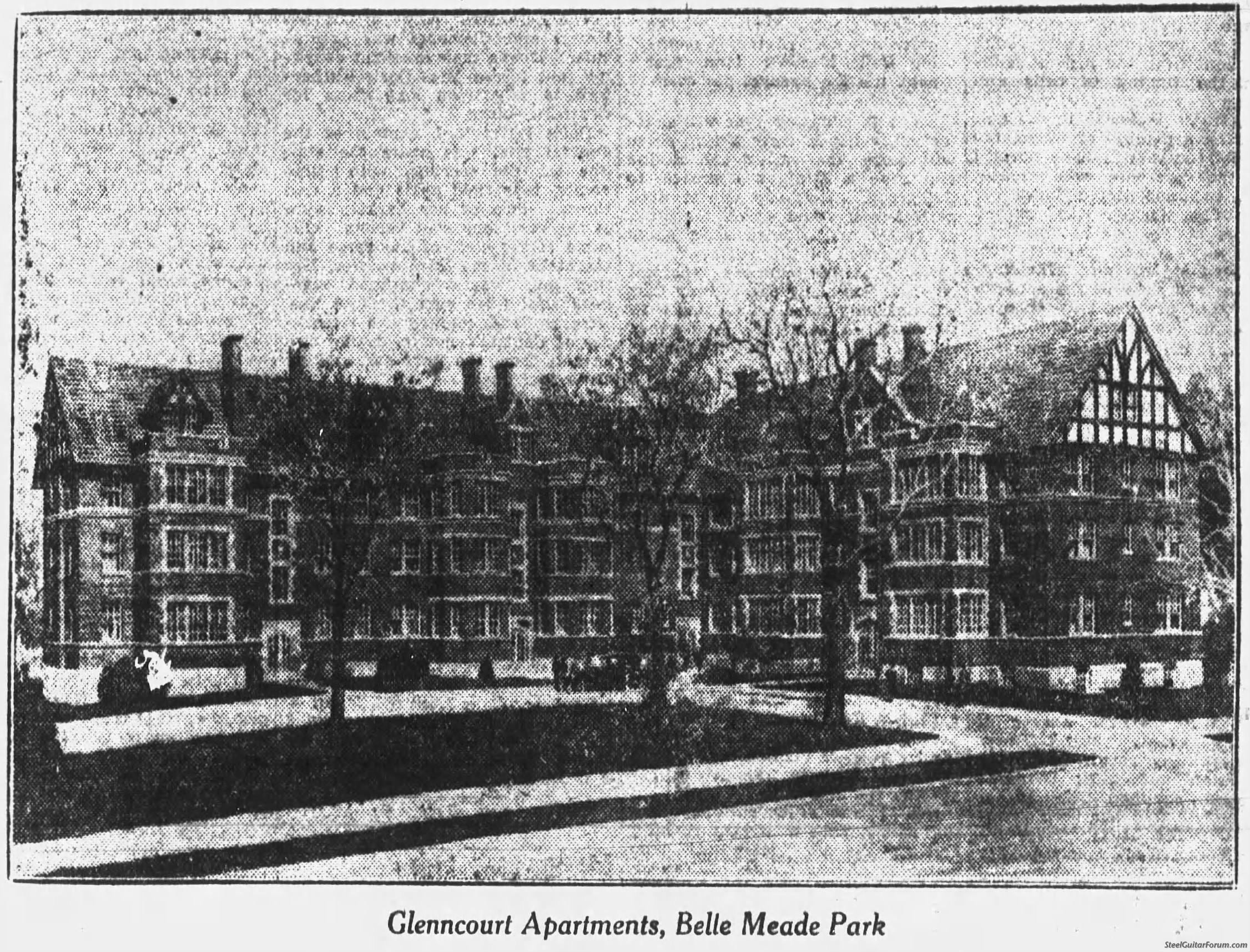
Glenncourt Apartments 715 Belle Meade Blvd.
On Sunday afternoon, November 25, 1918, Army Lieutenant Ivo Glenn participated in an airshow at the Tennessee State Fairgrounds 3 miles south of downtown:
"Lieut. Ivo Glenn, another Nashville birdman, will meet the visitors upon their arrival, and it is his purpose to establish a new high altitude record for this section which is now 7,500 feet. Lieut. Glenn hopes to be able to reach an altitude of 10,000 feet." (Nashville Banner, November 23, 1918)

(Nashville Banner, November 23, 1918)
Unfortunately, Lieutenant Glenn's exhibition flight was canceled:
"At 2 o'clock they appeared at the State Fair Grounds and gave an exhibition before several hundreds who were awaiting their arrival. The exhibition flight of Lieutenant Ivo Glenn, owing to lack of time, was postponed, and many Nashvillians who had gathered at the grounds to see this local airman perform were disappointed." (Nashville Tennessean, November 25, 1918)
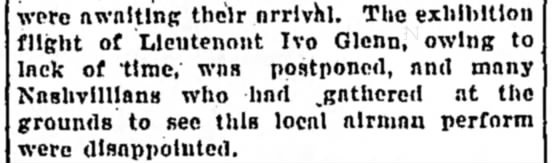
(Nashville Tennessean, November 25, 1918)
Ivo Burns Glenn died early at 44, Friday, August 9, 1935, at his residence in Glenncourt. The Glencourt, now the Belle Meade Apartments, still stands today at 715 Belle Meade Boulevard, across the street from the Golf and Country Club in Belle Meade Park, where Air Force Lieutenant Burns would land his Curtiss JN-4 ("Jenny") biplane.
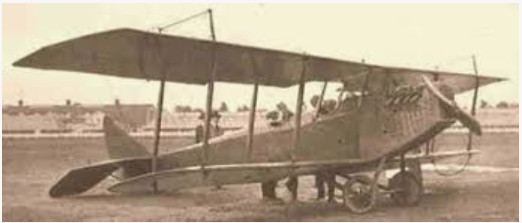
Curtiss JN-4 ("Jenny") biplane.
Two photographs appeared in the local papers: one with Ivo Glenn as a 27-year-old Army Cadet in training as an aviator in Austin, Texas, published in the Nashville Banner on March 7, 1918, and a second in his early 40s for his obituary published in The Nashville Tennessean on August 10, 1935. The only mention of Ivo Glenn as a ("wielder of the steel guitar") exists in the write-ups for his Vanderbilt Glee Club appearance published in the May 3, 1918, Nashville Tennessean and The Nashville American and the Nashville Banner.
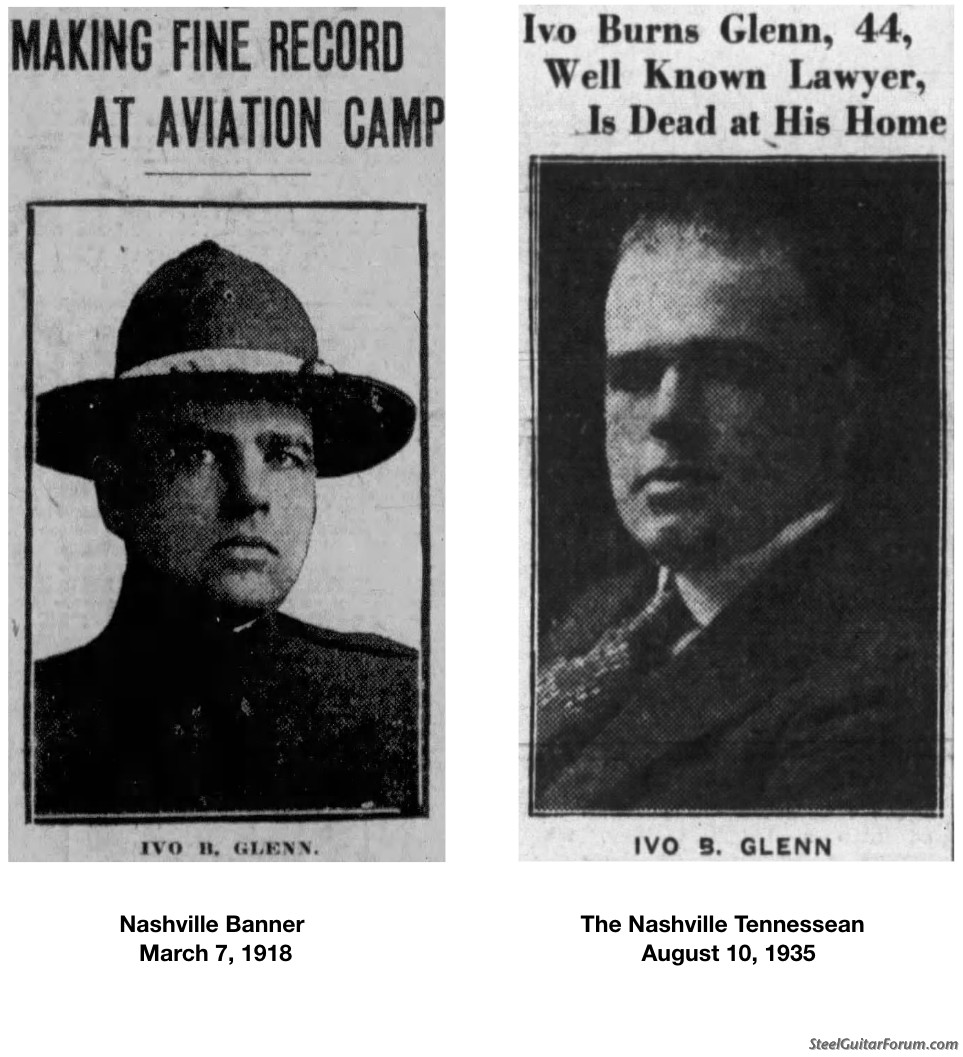
Ivo Glenn was not the first local steel guitar player in Nashville or was the the first to be mentioned in the local papers. A year before Ivo Glenn's May 4, 1917 appearance at the Loews Vendome, the July 7, 1916 Nashville Banner reviewed Sterling Melvin, another local steel player, performing on Sunday, April 2, 1916, at a boat party held in Centennial ParK on West End Avenue:

(Nashville Banner, July 7, 1916)
Here are photographs of Sterling Melvin and Grady Gowan. This was the first photograph published of a steel player, either a native Hawaiian or a local Nashville resident, playing a steel guitar within the Nashville city limits:

Pictured: Grady Gowan: sitting. Standing from left to right is Vernon Hafer: ukulele: Sterling Melvin: standard guitar, and Earl Hafer: standard guitar.
(Nashville Banner, January 13, 1918)
Many other local Nashville Steel players would follow after Ivo Glenn, Grady Gowan, and Sterling Melvin. Hawaiian-style steel guitar players, both professional and part-timers with day jobs, played around town long before the arrival, starting in 1938, of well-documented "Grand Ole Opry" steel players beginning with "Cousin Jody" (Clell Summey) with Roy Acuff and The Smokey Mountain Boys in 1938, "Bashful Brother Oswald" (Beecher Kirby) with Roy Acuff and The Smokey Mountain Boys in 1938, and Little Roy Wiggins with Paul Howard and His Arkansas Cotton Pickers in 1941.


